24/7 Emergency Aurora Plumber — Burst Pipes, Sewer Backups & Water Heaters Across Arapahoe County
Live dispatch around the clock from our Sable Boulevard base in Aurora, Colorado — serving Aurora City Center, Village East, Meadow Hills, Mission Viejo, Heather Gardens, Utah Park, Seven Hills, Smoky Hill, Tallyn's Reach and the surrounding Denver metro.
DeLaney Auro Plumbing is an emergency Aurora plumber with one trade and no side businesses. Since 2010 our thirty licensed professionals have handled burst supply lines, sewer backups, gas leaks, and water heater failures in single family homes, condos, HOA communities, rentals, and commercial buildings. Every repair is permit-backed, code-compliant, and photo-documented — built for Aurora's freeze-thaw winters, expansive clay soil, and the aging cast-iron and clay-tile drain lines under this side of the city.
Call a Licensed Plumber Now (720) 599-4699Get Emergency Help Now
Fill out the form — we'll contact you immediately!
Why Act Before Aurora's First Hard Freeze?
Aurora's first sustained freeze usually lands in October, and it does not announce itself. It finds the hose bib still connected to a garden hose, the irrigation zone that never got blown out, the supply line running through an unheated garage, and the crawl space vent nobody closed. Front Range frost depth runs roughly 36 inches, which puts shallow service lines and sprinkler mains squarely in the failure zone.
Around Aurora City Center, where much of the housing dates to the 1965–1985 building boom, the risk compounds — those homes were built before modern insulation standards and many still run original supply and drain material. Correcting a vulnerable line in October costs a few hundred dollars. Drying and rebuilding a finished basement in January costs tens of thousands.
Schedule a Pre-Winter Plumbing Inspection — Response Within 24 Hours
Why Do Pipes Burst in Aurora Homes After the First Freeze?
Water expands about nine percent as it freezes. The ice plug itself rarely splits the pipe — pressure builds between that plug and a closed fixture until the wall gives. Here is what most Aurora homeowners get backwards: the failure usually shows up when the pipe thaws, not while it is frozen. That is why our call volume spikes one to three days behind a cold snap rather than during it.
Colorado's chinook winds sharpen the effect, swinging temperatures forty degrees in an afternoon and releasing hundreds of frozen lines across the metro at once. A crack an eighth of an inch wide can push more than 250 gallons a day into a wall cavity — enough to saturate drywall, subfloor, and insulation long before anyone notices a stain.
24 Hour Emergency Plumbing Aurora Residents Can Actually Reach at 3 A.M.
Aurora spans roughly 155 square miles across three counties, so any company advertising one arrival time for the whole city is guessing. We route honestly. From our base at 63 S Sable Blvd, calls in City Center, Village East, Meadow Hills, Mission Viejo, Utah Park, Delmar Parkway, and Chambers Heights are typically our fastest.
Southeast Aurora — Smoky Hill, Saddle Rock, Tallyn's Reach, Beacon Point, Wheatlands — runs longer, and longer again in snow or during I-225 and Parker Road congestion. Our dispatcher gives you a real window for your actual address, not a marketing average.
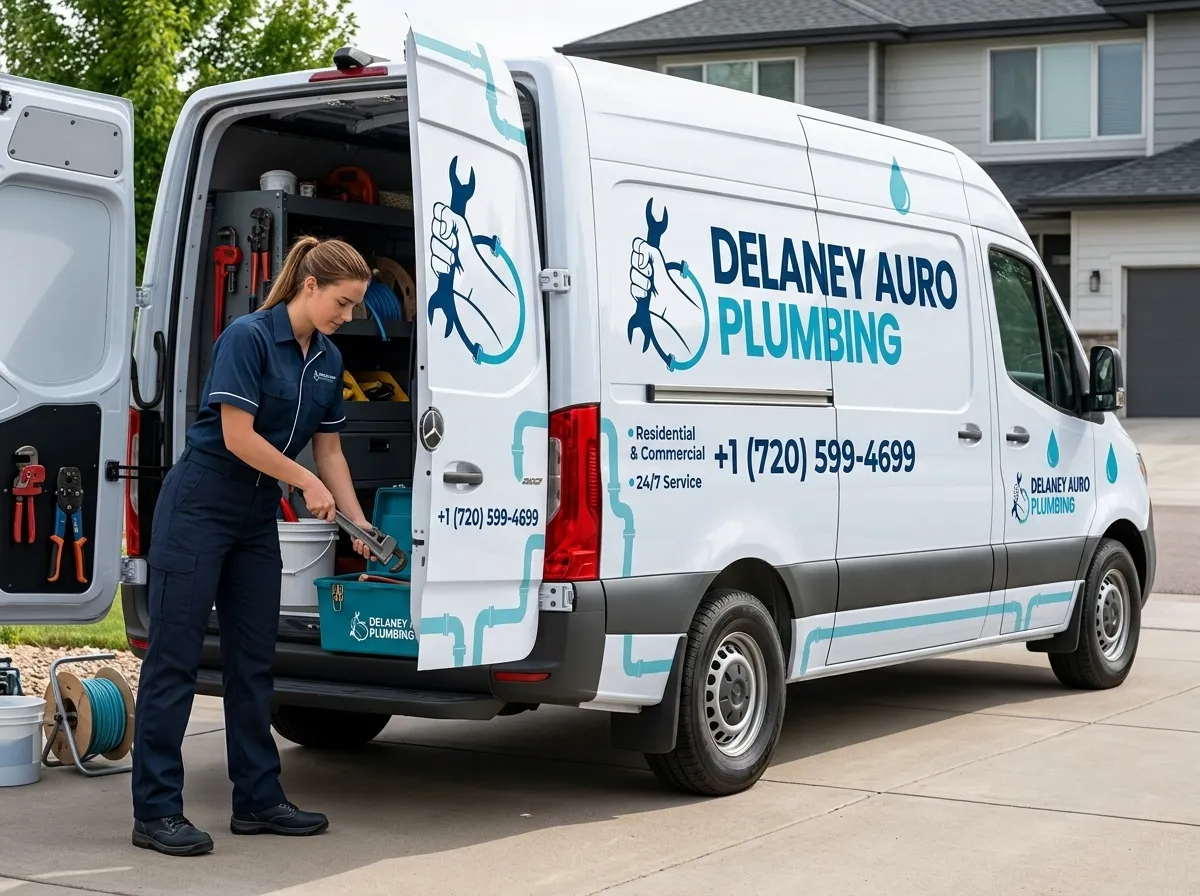
What's the Most Effective Emergency Plumbing Repair Method for Front Range Homes?
In Aurora's freeze-thaw, expansive-clay environment, a repair that lasts has three parts: stabilize the failure, correct what caused it, and rebuild to current code. Stabilization stops the water. Cause correction is the difference between a fix and a callback — a burst line in an exterior wall is usually a routing and insulation problem, and a recurring basement backup is almost always a bellied, root-invaded, or offset lateral rather than a clog.
Aurora is home-rule and enforces the 2021 International Plumbing Code, International Residential Code, and International Fuel Gas Code alongside the 2023 National Electrical Code, with its own local amendments layered on top. We repair with materials rated for this climate and this soil: PEX-A or Type L copper on supply, properly bedded PVC or cured-in-place lining on drains, frost-free sillcocks outside, and thermal expansion control wherever a closed system requires it.
1. Stabilize
Stop the water. Isolate the failure. Make the property safe within the first hour.
2. Correct
Find the cause — not just the symptom. Routing, insulation, and lateral condition, not just the visible leak point.
3. Rebuild to Code
Aurora's 2021 IPC/IRC/IFGC standards, proper materials, permits pulled, inspections passed.
How Aurora's Soil, Sewers, and Building Eras Shape Your Plumbing
Why DeLaney Auro Plumbing Wins — The Emergency Plumber Aurora City Center Homeowners Keep on the Fridge
Most home-service companies sell plumbing next to HVAC, electrical, and restoration, then rotate the same technicians between all four. Aurora's central corridor deserves better than a generalist. This part of the city sits on aggressive expansive clay, drinks water from a utility with its own chemistry and its own rules — and was built almost entirely inside a twenty-year window that straddles the most consequential date in Aurora plumbing: 1985.
DeLaney Auro Plumbing exists to answer one question: how do we permanently fix plumbing in Aurora homes and buildings? Every license, van, camera, and report format serves that question and nothing else. Our name comes from the same Aurora history as DeLaney Farm and the DeLaney Round Barn, and we intend to be here as long as they have been.
System Expertise — Water, Sewer, and Gas Lines Across Central Aurora
Aurora's failure patterns are predictable once you know when a home was built, and City Center sits right on the seam. Aurora Water advises homeowners to determine sewer line age and material, and notes that homes built after 1985 generally have PVC service lines, which are far more durable — the city also names root intrusion as a leading backup cause, since roots ignore an intact pipe but chase moisture at any crack or separation. Half this neighborhood is on the wrong side of that date.
Cast-Iron & Clay-Tile Lateral Diagnosis
Camera inspection, hydro jetting, and trenchless lining across Village East, Meadow Hills, Mission Viejo, Utah Park, and Delmar Parkway.
Galvanized & Polybutylene Supply Replacement
Full identification and repiping, with a written material assessment before you commit to a scope.
Gas Line Leak Service
Gas line leak isolation, pressure testing, and replacement, with the shutdown sequence explained before we touch a valve.
Freeze-Rated Repairs & Materials
We repair for the winter after next, not for tonight. Every at-risk line we touch gets corrected for the condition that caused the failure, because putting the same pipe back in the same place guarantees the same call next February.
Condo, HOA, Landlord & Property-Manager Workflows
Roughly four in ten Aurora households rent, and central Aurora carries a heavy concentration of condos, townhomes, and 55-plus communities. In those buildings the first real question is never "what broke" — it is "who pays." We answer it in writing before we start.
- Colorado's Common Interest Ownership Act designates fixtures designed to serve a single unit as limited common elements unless the declaration says otherwise — we document which side of the line your failure sits on
- Post-CCIOA condominium associations must insure units as well as common elements regardless of the declaration, though coverage need not extend to finished interior surfaces
- Time-stamped photo reports with technician initials, delivered to the owner, the manager, and the board before the invoice, plus tenant coordination and after-hours building access protocols
Emergency Commercial Plumbing Rescue
For a restaurant on Sable, a clinic off Mississippi, or a retail suite at Town Center at Aurora, a plumbing failure is lost revenue and sometimes a closed door. We work as a commercial emergency plumber Aurora operators call before they call their insurer.
- Priority dispatch for food service, medical, retail, office, and multifamily accounts facing shutdown risk
- Grease interceptor blockages, sanitary line failures, and floor drain backups handled with Aurora's wastewater pretreatment rules in mind
- Backflow assembly failures corrected and retested, so occupancy is never in question
Sewer Backups, Gas Leaks, and Contaminated Water in Aurora
A sewer backup is a biological exposure, not a cleaning inconvenience. Wastewater surfacing through a basement floor drain or a shower pan carries bacteria, viruses, and parasites, and it soaks porous material — carpet pad, drywall bottom plate, subfloor — that cannot be disinfected in place. Sewage backup is among the most expensive water losses to remediate precisely because full contamination protocols apply. The moment sewage reaches living space, the job shifts from convenience to containment.
Aurora's building code speaks to this directly. City Code 22-201 amends the residential code to require that floor drains be installed in a space in full view — they may not be placed in a crawl space or attic. That rule exists so a backup is seen early rather than discovered by smell three weeks later.
Gas deserves the same seriousness: a sulfur odor near an appliance, an audible hiss at a connection, or a pilot that will not hold is never a next-morning problem.
Water chemistry matters too. Aurora Water disinfects with chloramines at roughly 1.9 parts per million on average, and chloramine is harder on rubber than free chlorine — which is why flapper valves, supply-line washers, and older gaskets in Aurora homes fail earlier than their packaging promises. A weeping toilet here is often a materials problem, not a mystery.
Gas smell? Do not touch switches or the garage door opener — leave, then call the gas utility, then call us.
Sewer backup? Keep people and pets out of any room holding wastewater, and stop running other fixtures.
Sewage-soaked material? Treat as remove-and-replace, not clean-and-dry, especially in a finished basement.
Code-Compliant, Permit-Aligned Emergency Plumbing in Colorado
Colorado does not make you wait for a permit while your basement floods. Under the state's plumbing rules, emergency work may begin immediately and the required permit may be obtained the following business day — the rule names broken water lines, broken drain lines, and water heater replacements specifically. That is the legal basis for genuine 24 hour emergency plumber Aurora CO service at two in the morning, with no question about whether the repair was authorized.
What happens next is what separates licensed operators from the rest. By statute and the Colorado Plumbing Code, water heater installation and replacement requires a Board-issued plumbing license, a permit, and an inspection. An unlicensed installer will not pull that permit, and the gap surfaces years later during a buyer's inspection, or during a claim.
DeLaney Auro Plumbing holds Master, Journeyworker, and Residential plumbing licenses, registers its apprentices, carries backflow prevention certification, and maintains general liability, workers' compensation, commercial auto, professional liability, and tools and equipment coverage. We pull the permit. Every time.

What Is the Most Effective Way to Stop a Plumbing Emergency Fast?
The first sixty minutes belong to you, and what you do in them decides whether this is a repair or a restoration project.
Shut Off the Water at the Main
In most central Aurora homes it is in the basement or crawl space on the wall facing the street. Every adult in the household should know where it is before they need it.
Kill the Heat Source
Gas water heater to pilot or vacation; electric off at the breaker. A tank that keeps firing while empty destroys itself in minutes.
Open the Lowest Faucet
Drain line pressure and pull standing water out of the system by opening the lowest faucet in the house.
Cut Power to Affected Circuits
If water is near outlets, a panel, or a furnace — from a dry location only.
Photograph Everything
Before you clean anything. Insurers settle on documentation, and adjusters rarely accept a tidied room.
How We Compare to Typical Multi-Trade Home Service Companies
Aurora homeowners deserve a straight comparison. Here is how a plumbing-only, Arapahoe County-based operation stacks up.
| Company Type | Trade Focus | Aurora Knowledge | Pricing | Permits | Documentation |
|---|---|---|---|---|---|
| Multi-Trade Co. | Plumbing, HVAC, electrical, restoration | Metro-wide scripts, little neighborhood specificity | Membership upsell, quoted at the door | Usually licensed, permits inconsistent | Occasional, not systematic |
| Independent / Unlicensed | Whatever is asked | Variable, sometimes strong locally | Cash rate, no written scope | Frequently no permit pulled | Rare |
| DeLaney Auro Plumbing ✓ | Plumbing only — 100% of field work | Building era, soil, code, HOA structure, and sewer material by street | Written estimate before billable work, published offers | Master/Journeyworker licensed, permits pulled & inspected | Photo report on every job, standard |
What Makes Us Different
Our scope is narrow deliberately. Every hour of training, every item on the van, and every line of our reporting exists to fix plumbing in this city.
Plumbing only — no HVAC or restoration division pulling our technicians away on the coldest night of the year.
We ask what year your building went up before we quote a sewer repair, because in central Aurora the answer changes the repair.
Condo and HOA fluency — we document responsibility boundaries so owners, boards, and managers are not arguing about a scope while water is still running.
Permit-backed work — pulled, inspected, documented, and defensible at resale and at claim time.
Written estimates before billable work — scope, range, and exclusions in writing, no bait-and-switch.
Photo-documented repairs — before, during, and after, with technician initials, sent to you and your property manager.
Bilingual dispatch — se habla español, because nobody should have to describe a gas leak in a second language under pressure.
Is Hiring a Professional Emergency Plumber Worth It?
In Aurora, the math is not close once soil and code enter the picture. The Colorado Geological Survey identifies expansive, swelling soil as the state's most significant geologic hazard, causing more property damage annually than tornadoes, floods, earthquakes, and hurricanes combined, and it names the disruption of pipelines and sewer lines among the damage it causes.
Saturated bentonite clay can expand ten percent or more in volume and exert over 20,000 pounds per square foot against foundations, slabs, and everything buried between them. A patch on a sheared sewer joint does nothing about the clay that sheared it.
The second reason is evidence. Permitted, inspected, photographed work becomes documentation you can hand to an insurer, a buyer's inspector, or an HOA board. That is why 24 hour emergency plumbing services Aurora property owners rely on should always come with paperwork, not just a truck. Unpermitted work becomes a liability that surfaces at the worst possible moment.
Bottom line: Multi-trade companies treat plumbing as one revenue line among several. We treat it as the only one.
Before & After Emergency Plumbing Repairs in Aurora
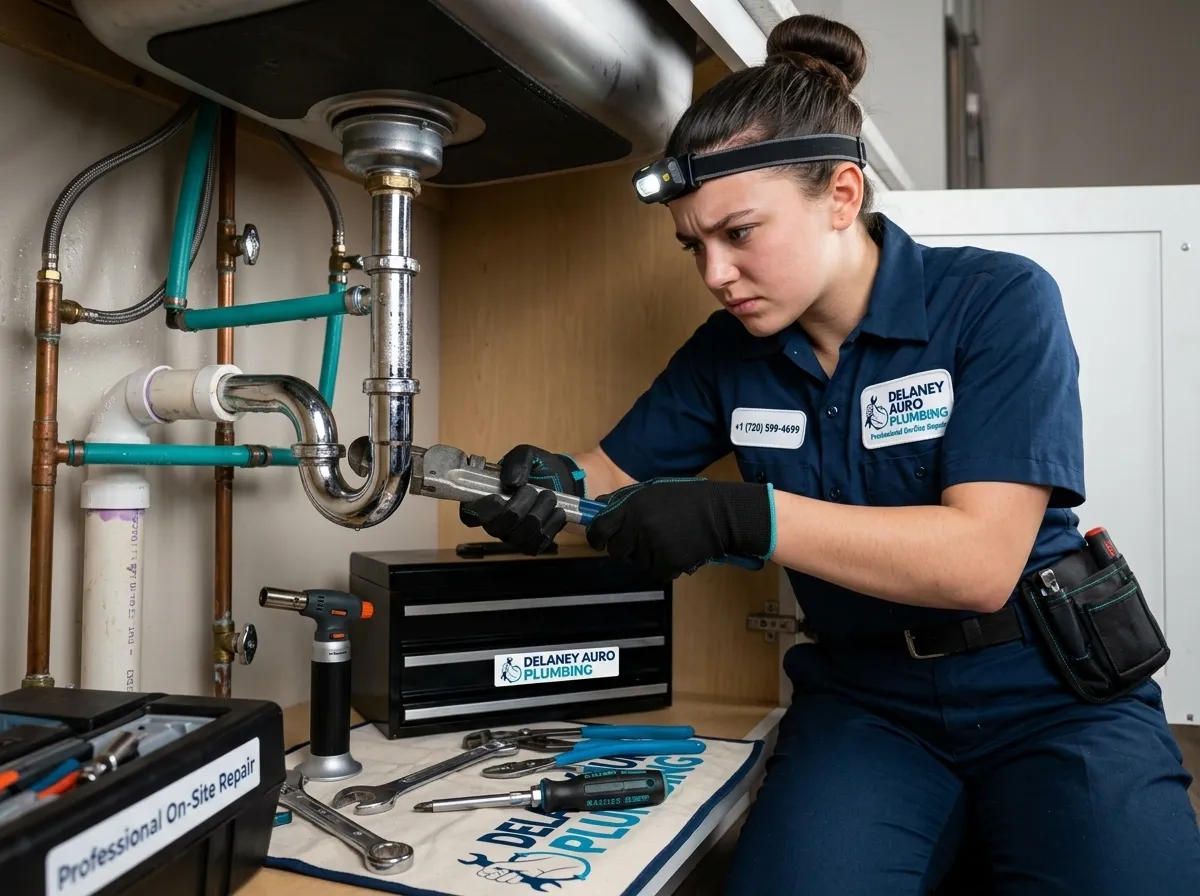
We do not use stock photography. Our before-and-after library documents real central Aurora projects.
A collapsed clay lateral lined without trenching a Village East driveway, cast-iron stack replacement in a Heather Gardens condo stack coordinated with the association, a 1972 Meadow Hills ranch repiped off failing galvanized, a backwater valve retrofit in a Utah Park basement that had backed up twice, and a code-compliant water heater and expansion tank rebuild near Town Center. Each image ties to a time-stamped job record, the permit number where one applies, and the technician's initials.


How Plumbing Fails in Aurora (Seasonal Calendar & Risks)
October–November — First Hard Freeze
The first sustained freeze exposes everything that was not winterized. Hose bibs still wearing a garden hose, irrigation zones that never got blown out, and supply runs through unheated garages fail first.
- Disconnect every hose and drain the sillcock before the first hard freeze
- Book the irrigation blowout and the annual backflow test in the same visit
- Insulate exterior-wall, garage, and crawl space runs while access is still easy
December–February — Deep Cold & Chinook Thaws
Denver Water has warned that eighty to a hundred or more consecutive hours below freezing can burst pipes inside a home. Aurora gets exactly that, then gets a chinook that lifts temperatures forty degrees in an afternoon. The thaw is the failure event.
- Hold the thermostat above 65°F even in an empty house, and open sink cabinets on exterior walls
- Run the faucet farthest from the meter at a slow drip during extreme cold
- If a fixture stops producing water, treat it as a frozen line and call before applying any heat
March–April — Spring Thaw & Soil Movement
Snowmelt saturates the clay and the ground starts moving. Laterals that survived winter shear at the joint, basements take hydrostatic pressure, and sump pumps that sat idle for four months are asked to run continuously.
- Test the sump pump before the melt, not during it
- Several slow drains at once points at the lateral, not the fixture
- Camera-inspect any line that backed up over winter, before roots find the new crack
May–September — Irrigation, Monsoon & Heat Load
Warm months move the load outdoors and upward. Irrigation comes back online and reveals winter breaks, backflow assemblies come due, and rooftop swamp coolers get charged with water again.
- Bring irrigation up slowly and walk every zone looking for winter breaks
- Schedule backflow testing early rather than during the seasonal rush
- Service the swamp cooler saddle valve and supply line at startup, not after the drywall stains
Scheduling Intelligence
Central Aurora routing is its own discipline. I-225 and Parker Road congestion, Alameda and Mississippi signal timing, shift changes at the Aurora Municipal Center and the Anschutz campus, R Line and Nine Mile transit traffic, two school district calendars, and snow-route restrictions all change what "fast" means depending on your address and the hour.
We plan around them: technicians staged by corridor, vans loaded by call type, and a dispatcher who tells you which window is realistic instead of quoting a citywide average.
How Can I Stop Plumbing Emergencies From Happening Again?
Prevention here is specific, seasonal, and cheap relative to the alternative.
Know Your Shutoffs
Main valve, water heater, and every fixture stop. Label them today, not at midnight.
Turn On Leak Alerts
Aurora Water's advanced metering gives hourly usage data and sends a continuous-flow alert when your meter records continuous use for at least 24 hours.
Camera-Inspect Pre-1985 Laterals
Aurora Water puts a plumber's video inspection at around $100 and calls it the reliable way to establish material and condition.
Consider a Backwater Valve
The plumbing code requires fixtures with flood-level rims below the elevation of the manhole cover to be protected by a backwater valve.
Clean the Lateral Annually
If you have mature trees — the city names root intrusion as a leading backup cause.
Install PRV & Expansion Tank
Where system pressure or a closed system requires one — protecting your water heater and plumbing fixtures.
What We Fix — From Symptoms to Targeted Repairs
No vague marketing here. Below are the signs Aurora homeowners actually describe on the phone, and what each one usually points to.
Spreading ceiling or wall stain
Supply line failure, a drain leak above, or a swamp cooler line in summer.
Every drain backing up at once
Main lateral obstruction or collapse, not a fixture clog.
Gurgling toilet when the washer drains
Venting failure or partial lateral blockage.
No hot water, or rust from the hot side only
Failed element, thermostat, or a tank at end of life.
Water pooling at the base of the water heater
Tank seam failure. This one does not wait until morning.
Sewer odor at a basement floor drain
Dry trap, failed wax ring, or a cracked drain line under slab.
Whole-house pressure loss
Service line break, frozen line, or a failing PRV.
Water bill doubled with no change in habits
Hidden slab, irrigation, or flapper leak.
Wet patch in the yard between meter and house
Service line break on your side of the meter — your responsibility in Aurora.
Every repair is documented with photos, a severity rating, and a recommended follow-up plan, so owners, boards, and remote landlords can see exactly what changed, what mattered most, and what to schedule next.
How Expensive Is Emergency Plumbing in Aurora?
Cost depends on three things: what failed, when you called, and how much of the system has to be corrected to keep it from recurring. Nationally, emergency plumbers average $100 to $350 per hour, with most charging a $150 to $250 service call fee or after-hours surcharge. Locally, Aurora drain cleaning averages around $184 with a typical range of $105 to $275, and Aurora sewer repair averages roughly $1,855 with a typical range of $975 to $2,634.
We publish numbers rather than hiding behind "call for a quote." You receive a written estimate with scope and range before any billable repair begins, and the number you approve is the number you pay.
One caution worth stating plainly: you may find references online to a municipal backwater valve subsidy in "Aurora." That program belongs to Aurora, Ontario, Canada. No equivalent rebate exists in Aurora, Colorado, and we will not quote you against one.
Current Special Offers
Our Proven 6-Step Emergency Plumbing Process
Quick Phone Triage (2–5 Minutes)
We start by stopping the damage, not by booking a slot. You tell us what you can see and hear — where the water is, whether it is clean or wastewater, whether anything smells like gas. We walk you to your shutoff over the phone, confirm children, pets, and electrical hazards, and take cross streets, unit numbers, and building access details.
On-Site Diagnosis & Photo Mapping
Your technician traces the failure to its cause rather than its symptom — pressure testing supply, camera-inspecting drains, and evaluating the meter, PRV, and water heater as one connected system. Every finding is photographed and rated by urgency.
Transparent Plan & Written Estimate
Before billable work starts, you get a written scope with pricing, timeline, and stated exclusions. Where two legitimate paths exist — a repair now versus a replacement that ends the problem — you get both with the trade-offs explained plainly. In a condo or HOA property, we identify which side of the responsibility line the work falls on.
Emergency Stabilization (Hour 1)
We stop the water, isolate the failure, and make the property safe. Where the permanent fix needs parts, excavation, or daylight, we install a sound temporary and tell you exactly what it is and how long it will hold. You are never left guessing whether the building is stable overnight.
Permanent Repair & Code-Compliant Replacement
We rebuild to Aurora's adopted 2021 IPC, IRC, and IFGC standards plus the city's local amendments, using materials rated for this climate and this soil. Permits are pulled the following business day where the emergency exception applies, and inspections are scheduled and passed.
Test, Document & Follow Up
Every repair is pressure-tested or flow-verified before we leave, and the work area is cleaned. You receive a photo report with before, during, and after images, technician initials, permit reference where applicable, and a short maintenance plan. We follow up to confirm the fix is holding.
What's Included in a DeLaney Auro Plumbing Emergency Call?
Our emergency call is built to take you from "there is water everywhere" to a documented, permanently corrected system with a clear plan.
Commercial & Multifamily Clients — Protect Your Doors, Tenants & Revenue
A plumbing failure in a commercial or multifamily building is a revenue event before it is a repair.
For restaurants along Sable and Mississippi, retail and food service at Town Center at Aurora, medical and professional offices near the Aurora Municipal Center, and condo and apartment portfolios across City Center and Village East, downtime is measured in closed doors and displaced residents. Our commercial plumbing scope is built around Aurora's actual compliance requirements rather than a generic checklist.
Aurora's wastewater control rules under Chapter 138, Article VI require grease interceptors at food preparation establishments — cafés, fast food outlets, pizza and sandwich shops, delicatessens, coffee shops, and comparable operations — along with schools and nursing homes, and require that they be pumped and cleaned quarterly or as often as necessary to stay effective.
On the water side, city ordinance 138-170 mandates operational testing of required backflow prevention assemblies by a certified technician at installation and annually thereafter.
Serving Aurora and the Denver Metro Since 2010
Every completed job generates a dated photo record, a technician's initials, a written scope, and — where the work requires one — a permit and inspection sign-off you can independently look up. That is verifiable proof rather than a slogan.
We are licensed at the Master, Journeyworker, and Residential levels under Colorado's regulatory framework, we register our apprentices, we hold backflow prevention certification, and we carry general liability, workers' compensation, commercial auto, professional liability, and tools and equipment coverage.
Sixteen years in this city, thirty people, five fully equipped vans, one trade. We are not a national brand routing your call to a distant center, and we are not a lead broker selling your address to whoever bids highest. When you call DeLaney Auro Plumbing, you reach our dispatcher, and our technician arrives.

Our Emergency Plumbing Services in Aurora
We cover the full plumbing system for homes, condos, rentals, and commercial properties across Aurora and the surrounding metro.
Burst Pipe & Frozen Line Repair
Supply failure, thaw damage, and full repiping
Sewer Line Repair & Replacement
Clay tile, cast iron, trenchless lining, and open-cut
Drain Cleaning & Hydro Jetting
Fixture clogs through main lateral obstructions
Sewer Camera Inspection
Pre-purchase scoping and post-backup diagnosis
Water Heater & Boiler Repair
Tank, tankless, and code-required expansion control
Water & Gas Line Repair
Service line breaks, leak isolation, and pressure testing
Leak Detection & Slab Leak Detection
Located precisely before anything is demolished
Sump Pump Repair & Replacement
Spring melt and hydrostatic protection
Backflow Testing & Repair
Annual compliance for irrigation, commercial, and fire lines
Toilet, Faucet, Shower & Disposal
The everyday failures, done properly
Water Softener & Filtration
Sized to Aurora's real water chemistry
Commercial Plumbing & Restoration
Occupied-building response and cleanup
What Is the Fastest Way to Stop Water Damage Before the Plumber Arrives?
Shut off the water at the main. That single action prevents more damage than everything else combined. Then:
Cut power to affected circuits from a dry location
Turn the water heater to pilot or off at the breaker
Open the lowest faucet to drain the lines
Lift valuables and electronics off the floor
Photograph the damage before you clean — insurers settle on documentation
Stay off the affected floor and let the professionals handle the rest
We're Happy to Help
If you cannot find what you need here, call and we will walk you through the likely cause, the likely cost, and whether it can safely wait until morning.
Our dispatcher answers around the clock — nights, weekends, holidays — and we will tell you honestly when the right first call is Aurora Water rather than a plumber. Aurora Water's after-hours emergency line is 303.739.6772, staffed from 5 p.m. to 7 a.m. and on weekends and holidays — that is the correct number for a main break or a meter-side problem. For anything on your side of the meter, one call to your emergency Aurora plumber gets it stabilized, repaired, permitted, and documented.
We provide 24/7 live dispatch from 63 S Sable Blvd. Response times depend on your address and traffic conditions. City Center, Village East, Meadow Hills, and Mission Viejo are typically fastest. Southeast Aurora runs longer. Our dispatcher gives you a real arrival window for your actual address — not a marketing average.
Yes. Under Colorado plumbing rules, emergency work may begin immediately and the required permit is obtained the following business day. We hold Master, Journeyworker, and Residential plumbing licenses and pull permits on every qualifying job — no exceptions.
Emergency plumbing typically costs $100–$350 per hour with a $150–$250 service call fee. Aurora drain cleaning averages $184 and sewer repair averages $1,855. We provide a written estimate before any billable work begins. Current offers include $83 drain clearing and up to $750 off a new water heater.
Yes. We specialize in condo and HOA plumbing, providing written responsibility documentation identifying which side of the common element boundary the failure sits on, in compliance with Colorado's Common Interest Ownership Act. We coordinate directly with boards, managers, and tenants.
Do not touch switches or the garage door opener. Leave the building immediately, then call the gas utility, then call DeLaney Auro Plumbing at (720) 599-4699 for gas line leak isolation, pressure testing, and repair.
Serving Aurora Homeowners and Businesses Since 2010
We stand behind the work. Every repair carries a written scope, a photo record, and — where code requires one — a pulled permit and a passed inspection. If a repair we completed does not hold, we return and make it right under the terms stated on your estimate.
That commitment covers our full service area, from Aurora City Center and Village East east through Smoky Hill, Tollgate Crossing, Saddle Rock, and Wheatlands, and out to the surrounding metro communities we work in daily.
Company Gallery — Real Homes. Real Repairs. Real Results.
See how we stop the water, correct the cause, and rebuild to code across central Aurora's condos, ranches, and commercial suites.


What's the Best Emergency Plumbing Near Me in Aurora?
If you are searching for emergency plumbing near you in Aurora at eleven at night with water crossing a basement floor, the short answer is this: you want someone licensed, insured, local, and specific — a company that pulls permits, quotes in writing, and knows why a 1974 ranch off Sable fails differently than a 2016 build past Gun Club Road, and who pays for what when the failure happens in a condo.
That is what we do. Burst pipes, frozen lines, sewer backups, water heater failures, gas leaks, slab leaks, sump pump failures, and commercial interceptor and backflow emergencies — one trade, done properly.
Coverage runs across Aurora and into Denver, Englewood, Greenwood Village, Thornton, Northglenn, Westminster, Arvada, Lakewood, Littleton, and Brighton, with live dispatch nights, weekends, and holidays.
Call DeLaney Auro Plumbing and get it handled properly the first time.
Contact DeLaney Auro Plumbing — Aurora's 24/7 Emergency Plumber
Contact DeLaney Auro Plumbing
(720) 599-4699
63 S Sable Blvd
Aurora, CO 80012
24/7/365 — Live Emergency Dispatch
Nights · Weekends · Holidays